Here are some frequently asked questions when running ads on Facebook
Are you struggling with questions like what time is the most effective to run ads? What do you need to run Facebook ads? Will you lose money if you cancel a Facebook ad? If this is your first time delving into Facebook advertising, don’t miss this article. It will provide you with valuable experience to help you successfully run ads.
Marketing on Facebook is no longer new to online business enthusiasts. Among the strategies, reaching customers through advertising is the top priority. We have compiled the most frequently asked questions when running ads on Facebook.
1. Should I learn to run Facebook ads myself or hire an agency?
2. How should I target my audience effectively for this product/service?
3. How can I increase the Facebook ad budget efficiently?
4. If duplicating an ad set causes repeated ads, what should I do?
5. How can I grow likes and engagement for a newly created fan page?
6. What’s the best way to test an ad campaign?
7. What should I do if I get likes but no sales, and the costs are too high?
8. What is the best time to run ads?
9. What do I need to run Facebook ads?
10. Will I lose money if I cancel a Facebook ad?
1. Should I learn to run Facebook ads myself or hire an agency?
“I want to run ads myself!” That’s great! Many small and medium-sized businesses or shop owners prefer learning to run Facebook ads themselves rather than hiring agencies or outsourcing. After all, business owners understand their products best. Moreover, starting with Facebook ads isn’t particularly difficult nowadays. All you need is a VISA card connected to your fan page.
However, this is not the main reason many business owners take on the additional task of running ads. The economic equation between ad costs and revenue is the primary driver for many to learn Facebook ads. Often, these individuals have either heard about the inefficiency of outsourced ad services or, unfortunately, experienced dealing with subpar agencies that “burn through money without generating sales.”
If you find yourself in this situation, it might be time to seek out a professional agency. A reputable agency typically handles large-scale projects. They can provide you with a long-term plan, including a detailed monthly advertising roadmap for the year. They also have skilled leaders and technicians known for their expertise in the industry, as well as established partnerships with Google and Facebook. These professionals don’t just make promises; they demonstrate their commitment through tangible actions.
Therefore, if you don’t have 1-2 years to dedicate to learning advertising from scratch—burning through hundreds of millions of dong in tuition and trial-and-error costs—I strongly advise you to hire a professional agency to run your ads.
2. How should I target my audience effectively for this product/service on Facebook?
Targeting the right audience is always a key concern when running Facebook ads. So how do you target correctly?
One common mistake I see many newbies make is believing that their ad content is already good, and if their ads don’t perform well, it’s solely due to targeting. As a result, the number of people asking about targeting is overwhelming, yet I rarely see anyone ask: “Can you check if my ad copy looks good?” or “Does this photo I took/designed look okay?”
Content is crucial. If your content isn’t engaging or convincing enough to make customers buy, even perfect targeting won’t result in sales. Every day, people see countless ads—why would they buy from you? If they see ten ads for the same product, they’ll choose the one that looks more appealing, perhaps cheaper, or with better visuals (because they believe good visuals reflect good products). They might also choose the ad that addresses their problem directly or demonstrates a deeper understanding of their needs.
Writing ad content is challenging because, in addition to understanding your product, you need the skills to articulate its value, address the customer’s pain points, and be creative—especially if your product faces heavy competition. Due to this difficulty, content is often the root problem. To determine if your content is the issue, you should create multiple versions and test them on the same audience. This way, you might find a few pieces that actually convert.
If your targeting is wrong, of course, you won’t sell anything. Correct targeting requires analyzing your potential customers’ real-world interests and behaviors, then figuring out how those translate to their Facebook activity. There are different types of audiences: those who currently need your product/service or those who might need it in the future.
For example, if you’re selling travel tours, you know there are two types of people: frequent travelers and occasional travelers. Let’s say you focus on frequent travelers to close sales faster. Ask yourself: What do travelers typically do? For instance, they move from one place to another, which Facebook might recognize as travel behavior. They may shop for travel items like clothes, shoes, bags, backpacks, or suitcases. If so, they might have liked pages related to these products, and Facebook would categorize them as having these interests.
You should analyze their prior interests or behaviors. For instance, if you sell baby products, your customers likely got married first (engaged/married), then started following pregnancy or parenting-related content, searching for baby care guides, etc.
By following this method, analyze your product’s potential customers because only you truly understand your buyers.
3. A common question: “How can I increase the Facebook ad budget effectively?”
From my recent experience, significantly increasing the ad budget doesn’t necessarily make the campaign more effective. This happens because, with a higher budget, Facebook Ads may start targeting broader or different audiences rather than optimizing to reach those most likely to interact with your content. As a result, increasing the budget too much can sometimes lead to similar or even worse performance compared to the original budget.
The hard-learned lesson is to increase the budget by only 30-40% at a time. Avoid making large jumps. If you want to scale up significantly, you should duplicate your ad set/campaign (either by copying the existing one or creating a new one from scratch while keeping the same audience). After duplicating, you can tweak each ad set to target slightly different age ranges or other parameters to avoid overlap. However, avoid editing the original ad set, as it may lose its effectiveness.

See more products: Buy advertising accounts
4. If duplicating an ad set causes repeated ads, what should I do?
After duplicating an ad set, some people worry that the ads will repeat if the age range of the target audience remains the same across the sets. It’s true that repetition happens. However, repetition is normal—even within a single ad set. For example, the frequency of an ad can reach 2, 3, or even 4, yet it still doesn’t fully reach the potential audience.
In my opinion, repetition can be a good thing in many cases. For instance, the first time someone sees your ad, they may not notice it or have an urgent need to purchase. But on subsequent views, they might. This is why repetition has value and is the basis of remarketing.
Facebook has the ability to self-optimize, so by duplicating multiple ad sets, you may discover a few more effective ones.
5. How can I grow likes and engagement for a newly created fan page?
You should create your page around trending topics (naming and producing content that aligns with the trend) to naturally attract more likes. Once your page gains traction, you can rename it to reflect your brand.
Another approach is to boost likes through promotions or mini-games with prizes, requiring participants to share and like your page as a condition. This will help increase likes. Alternatively, you can focus on creating meaningful content that resonates with the community and consistently maintain and nurture your page.
See more products: Buy advertising accounts
6. How to Test Facebook Ads
Although the question is a bit broad, I assume you’re asking how to test your ads effectively to achieve better results.
There are two key elements you need to test: content and targeting.
- Test Content:
Create two or more variations of your ad content and run them with the same target audience. This will help you identify which content performs better. Don’t rely on your own opinion to judge whether your content is good. The ultimate judges are your potential customers. They read the content, find it appealing, and make a purchase—customers won’t buy just because you, as the shop owner, think the content is great. - Test Targeting:
Once you identify the better-performing content, use it to test different targeting options. For example, if you’re unsure whether to target people with Interest A or Interest B, run tests to determine which group responds better.
7. Getting Likes but No Sales, High Costs – How Can I Lower the Cost?
Running ads that result in sales is a process that can’t be summarized in just one post. I’ll simplify the explanation by assuming a simpler scenario to make it easier to understand. When running ads, you may encounter situations like: no sales, few sales, or many sales.
If you’re getting few sales, that’s still progress because it means you’re close to making it work. Low sales suggest that your content and targeting are on the right track—just a few tweaks can improve the situation. Improvements can be made through the content, targeting, or imagery.
For example, if your interaction costs are low but your comment costs are high, it’s usually a result of your content. You can enhance the content by writing more engaging copy, using a more attractive headline, creating a promising introduction, and addressing the customers’ problems. Run the improved ad with the same audience.
If both interaction costs and comment costs are high, it could be due to poor imagery, unattractive headlines, or targeting the wrong audience. In this case, you need to change the imagery or adjust your audience.
If you’re getting no sales at all, then you should start from scratch: analyze your customers’ behaviors and preferences again, review your product, and figure out how to approach it more effectively.
8. What Time Should I Run My Ads?
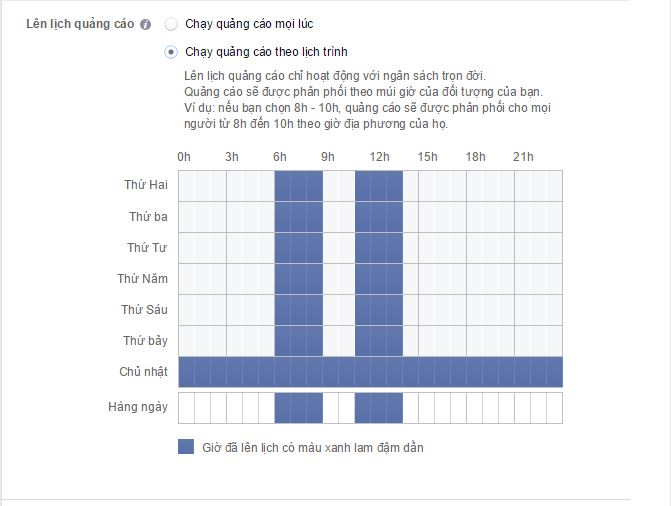
Each fan page is created to serve a specific audience, so the age, needs, and interests of the followers can vary. For example, if you develop a fan page targeting women, such as “Women’s Corner,” the people who like your page will likely be aged 18-34, with interests in beauty, lifestyle, skills, sharing, and personal stories.
From my experience testing on a fan page, I found that the optimal posting time is around 6:30 AM. You may be surprised, but the time frame between 6:30-8:30 AM is actually ideal for posting product or service introduction content on a Facebook fan page. Research has shown that 80% of users aged 18-44 check their smartphones immediately after waking up, meaning this time frame (6:30-8:30 AM) is key. Try posting during this window and you may be surprised by the engagement and reach of your posts.
See more products: Buy advertising accounts
9. What Do You Need to Run Facebook Ads?
- Fanpage: You need a fan page, and it must have content displayed under that page name. This content is what grabs people’s attention and is commonly referred to as “content.” To sell, just create a page quickly.
- Facebook Account: Within your Facebook account, you need an Ads account. This Ads account requires a payment method, and the payment method must have… money. The most common payment method in Vietnam is a bank card that can process international payments. Anyone wanting to run Facebook Ads should get one. Any bank card will do—don’t overthink it.
- Target Audience: Whether broad or narrow, you must identify and define your target audience. If you’re just starting with ads, focus on mastering how to define your audience using Facebook’s filtering tools based on location, age, gender, profession, interests, etc. I’ll provide a guide on different audience types on Facebook later.
- Knowledge: You should have a basic understanding of marketing and be familiar with Facebook’s measurement metrics, such as CPC, CPM, CTR, CPA, etc.
Once you have these basics in place, start watching tutorial videos and practice two things: writing content using templates and targeting simple audiences. The rest of the steps are just actions—anyone can follow them the same way.
10. Will I Lose Money if I Cancel a Facebook Ad?
If you delete an ad while it’s running, rest assured that the ad will stop, and you won’t incur any additional charges. The system will only charge you for the period from when the ad started running until it was turned off. Any unused budget will be retained and will not be included in your final bill.
From the article above, you now have the answers to questions like whether increasing your Facebook ad budget will improve results, what times are best to run ads to attract customers, and when to run ads for optimal efficiency, right? If so, why not go ahead and launch your own ad campaign right now?
If you need the most reputable payment method and advertising account provider, you can message the fanpage buybm365.com-Ads to receive advice from HT Media. In addition, you can follow the articles. Latest articles related to our Digital Marketing.