Cost of running Facebook ads: Influencing factors and ways to effectively distribute and optimize costs
With 1.6 billion people worldwide connected to small businesses on Facebook fan pages, Facebook is an attractive platform for marketers for many reasons, including the reasonable cost of running Facebook ads. However, planning a Facebook ad budget might seem a bit difficult and ineffective when you’re just starting out. How should you determine the cost of Facebook ads, allocate your budget, and reduce your ad spending? Let’s dive into the details in our article!
I. How to Determine the Cost of Running Facebook Ads
2. Cost Per Result
You control ad spending through bidding strategies. With cost per result, you can ensure that you don’t exceed your desired budget by setting spending limits for the campaign or account.
Did you know: You will only pay one cent more than the nearest competitor’s bid.
This means that if your bid is $2 and the highest bid from a competitor is $1.22, you will only pay $1.23 for your ad placement.
Types of Cost Per Result:
- CPC Ads – Cost Per Click: Drives targeted users to your website/landing page.
- Facebook CPM – Cost Per 1,000 Impressions: Increases brand recognition.
- CPV – Cost Per View: Delivers your message, attracts targeted users.
- CPA – Cost Per Action: Price per conversion. The goal is to encourage users to take actions like filling out forms, registering for events, installing apps, etc.
- CPL – Cost Per Like: Boosts likes on the page, helps grow the fanpage.
II. Facebook Advertising Costs
To answer the question “How much does Facebook advertising cost?”, you can use the average Facebook Ads cost based on your industry as a benchmark, and then set your bid accordingly.
1. Facebook Advertising Costs by Country
The average cost of Facebook ads, as reported in The Facebook Ads Benchmark Report (Salesforce.com), can serve as a guide for applying a bidding model for your business.
| Metrics | Malaysia | Singapore | Vietnam | Taiwan | Australia |
| Cost per App Install | $0.89 | $0.94 | $0.90 | $0.26 | $1.46 |
| App Install Rate | 0.016% | 0.037% | 0.008% | 0.013% | 0.023% |
| Cost per Page Like | $0.48 | $1.08 | $0.24 | $0.26 | $0.85 |
| Page Like Rate | 0.071% | 0.031% | 0.013% | 0.073% | 0.075% |
| CTR | 0.79% | 0.70% | 1.55% | 2.13% | 0.31% |
| CPC | $0.10 | $0.32 | $0.06 | $0.11 | $0.38 |
| CPM | $0.50 | $1.37 | $0.96 | $1.50 | $1.11 |
Facebook Advertising Costs by Country
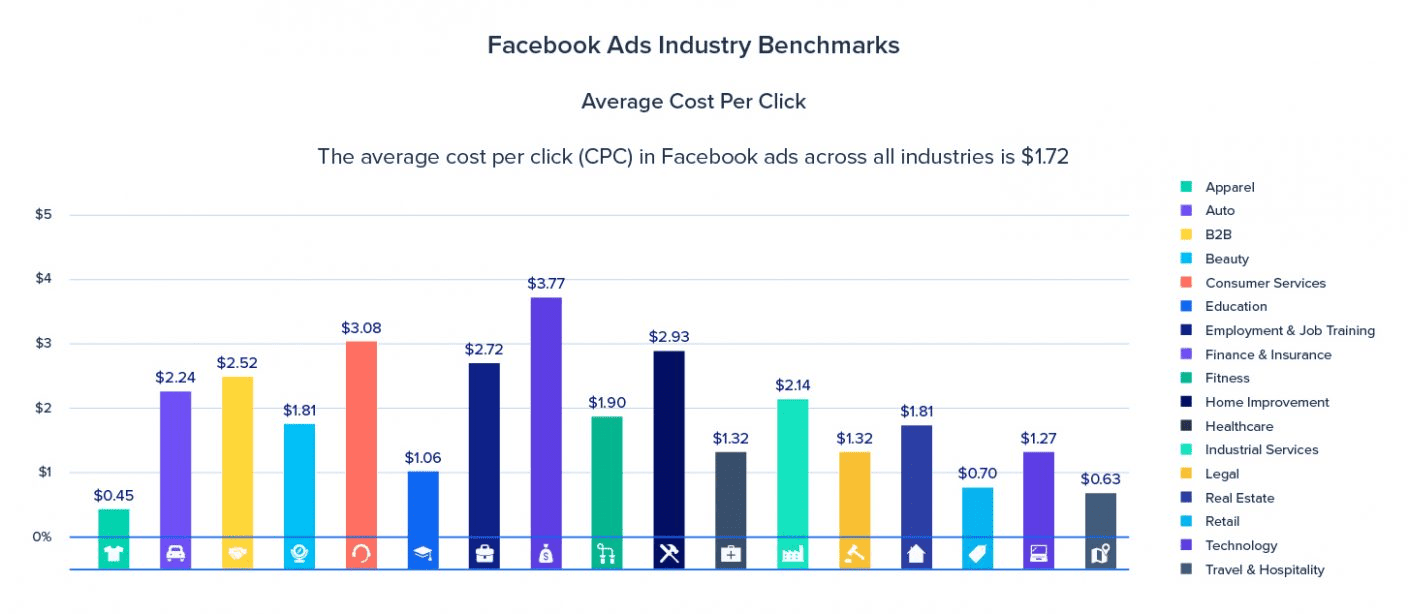
According to statistics, if using CPC, the cost of Facebook ads is approximately $0.06 (about 1,380 VND), while using CPM, the cost of Facebook ads is around $0.96 (about 22,080 VND) for every 1,000 impressions.
See more products: Buy advertising accounts
See more products: Buy advertising accounts
2.2 CPA – Cost per Action on Facebook by Industry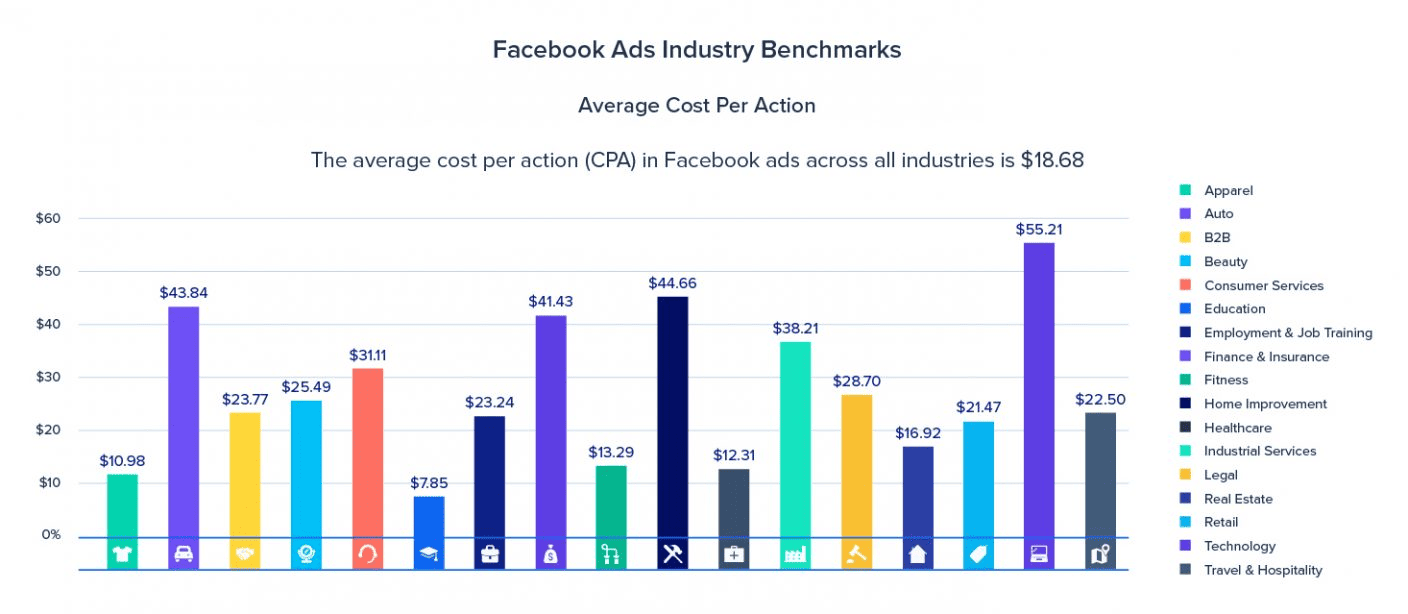
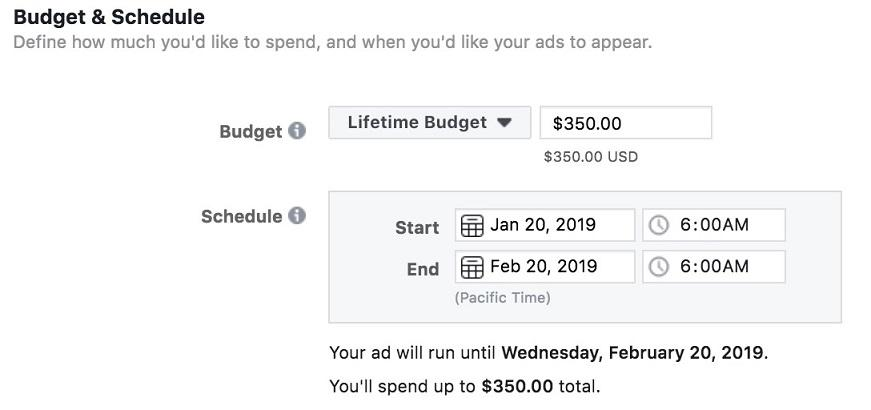
See more products: Buy advertising accounts
2. Audience
Defining your target audience significantly impacts the cost of your Facebook ads. Whether you are focusing on demographics, behavior, or specific interests, there are unpredictable changes in Facebook Ads costs.
For example, ads targeting women may cost more than those targeting men. Additionally, reaching an audience in the age range of 55-65 may be more expensive than ads focusing on users aged 25-34. This is because the number of users aged 55-65 on Facebook is only 26 million, while the number of users in the younger age range of 25-34 is over 58 million.
Moreover, targeting a very narrow audience may result in slower ad delivery and difficulty reaching potential customers, despite significantly reducing costs.
3. Ad Bid
Facebook offers two bidding strategies. In most cases, manual bidding comes with higher ad costs, while automatic bidding tends to make the most of your budget.
- Lowest Cost Bidding Strategy – Automatic Bidding: This option helps businesses achieve the lowest possible cost per result (click/action). Many businesses tend to start with this efficient budget strategy when running Facebook ads.
- Target Cost Bidding Strategy – Manual Bidding: The goal of this option is to achieve a desired cost per result (click/action), such as $5 per click. This strategy can only be used for campaigns involving app installs, conversions, lead generation, or product catalog sales.
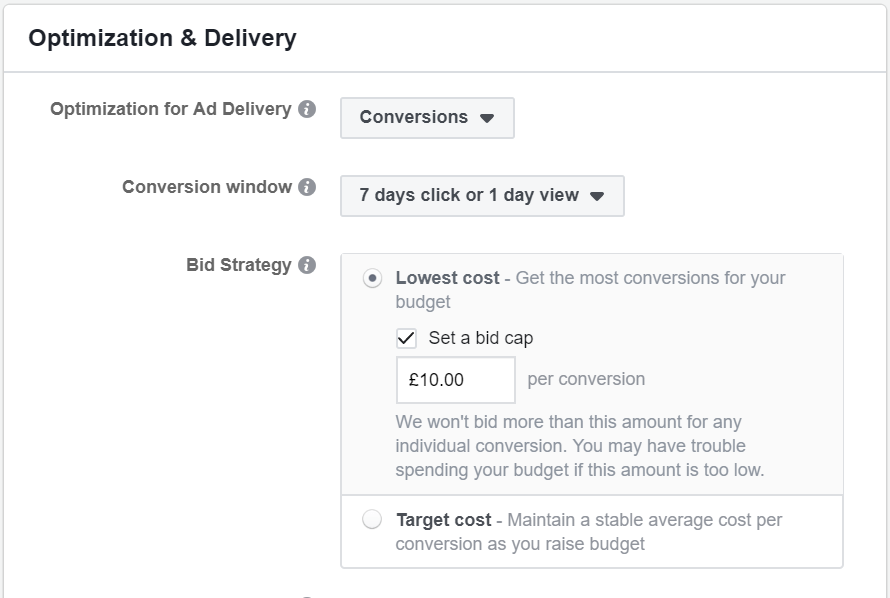
In an ad auction, Facebook evaluates each bidder and their ads based on three factors: bid amount, estimated action rate, and ad quality and relevance. A higher bid can increase the level of competition and your total value, but it can also raise your Facebook ad costs.
4. Facebook Ad Objectives
Facebook offers three main advertising objectives: Awareness, Consideration, and Conversion.
In most cases, Conversion objectives are more valuable, such as store visits, event participation, or product purchases, which results in higher advertising costs.
5. Competition
The cost of advertising on Facebook largely depends on how many competitors you have, what they are willing to spend, and how relevant their ads are.
If fewer businesses are trying to target your audience, there will be less competition, and thus your Facebook ad costs will decrease.
6. Facebook Ad Placements
Some popular and effective ad placements on Facebook include: Facebook News Feed, right column of Facebook, Instagram News Feed, Stories, and more.
7. Ad Quality
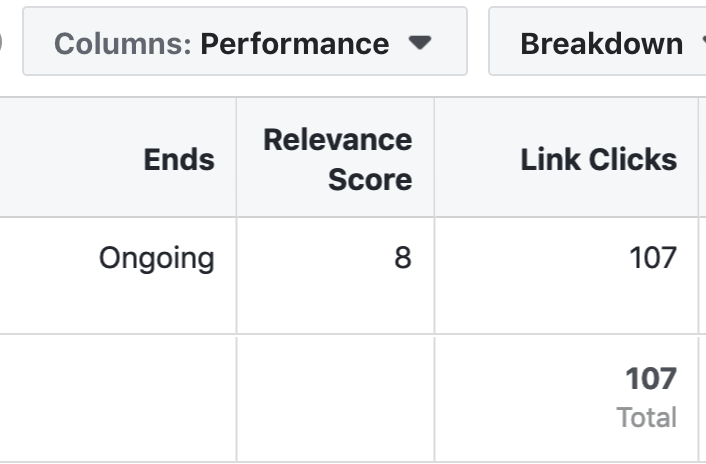
If you create ads that are highly relevant and have a high-quality score, you’ll see lower ad costs. This was proven in a recent Hootsuite study: Ads with a quality score of 2.9 had an average CPC of $0.14, while ads with a quality score of 8 had a CPC of $0.03.
8. Industry
You can gain a better understanding of the expected Facebook ad costs by looking at the average price of Facebook ads in the industry you operate in.
Depending on your field, Facebook ads can offer a cost-effective option for building brand awareness, generating leads, or driving conversions. For example, Facebook ads related to insurance, finance, or spas tend to be more expensive compared to fashion product ads.
9. Time of The Year
There are peak times of the year, such as holidays, when advertisers flock to Facebook Ads in large numbers, often more than usual. During these periods, you’ll have to spend more on ads due to the high level of competition.
IV. How to distribute Facebook advertising budget
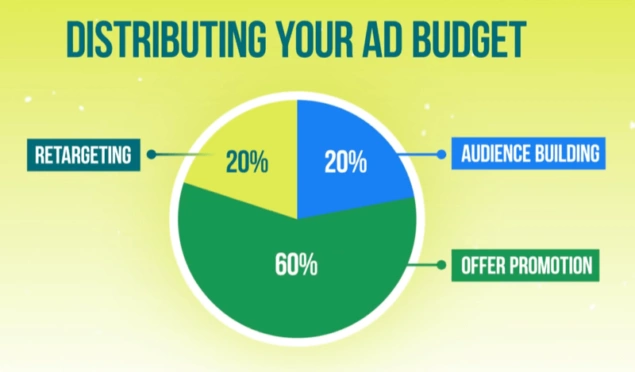
According to Social Media Examiner, the world’s largest social media marketing resource, you should allocate your monthly ad spend on Facebook Ads into three categories: audience building, offer ads, and retargeting.
- Audience Building – 20% The goal of audience-building ads is to raise brand awareness, introduce your products or services to potential customers, and encourage them to engage with your business.If you’re just starting to set up your ads, this 20% may be higher.
- Offer Ads – 60% At this stage, you’ll be targeting potential customers. Allocate about 60% of your total ad budget to promoting products and driving conversions.
- Retargeting – 20% Use the remaining 20% to retarget those who have visited your website or landing page through previous ad campaigns.Over time, you can increase your ad spend on retargeting, but make sure you always have new people interested in your store. Otherwise, your retargeting audience will be too small to generate results.
You should aim for a specific audience with a size of about 500,000 or more. Here are some audience targeting strategies to apply:
- If your store is still new, use Core Audiences to define your ideal customers.
- If you’ve already received traffic and sales, use Custom Audiences to retarget people who have abandoned their shopping carts or encourage purchases.
- Finally, use Lookalike Audiences to find people similar to your best customers.
2. Set Bid Limits
For example, if the cost per message for a product is 30,000 VND, you should set your bid around 60% of that amount. The principle is that when you set a bid, your ad will not be shown to people with costs higher than your set amount. This will reduce Facebook Ads costs. The downside is that your ads will not be delivered as quickly.
Duplicate Campaigns and Ads
Most people will increase the budget for effective campaigns, ad sets, or ads. However, a more cost-effective method is to duplicate and increase the budget in a new campaign. This will minimize the impact on the performance of the old campaign.
Additionally, you can duplicate the campaign to another ad account or duplicate ads to a new page to avoid overlapping target audiences.
Choose the Right Facebook Ad Format
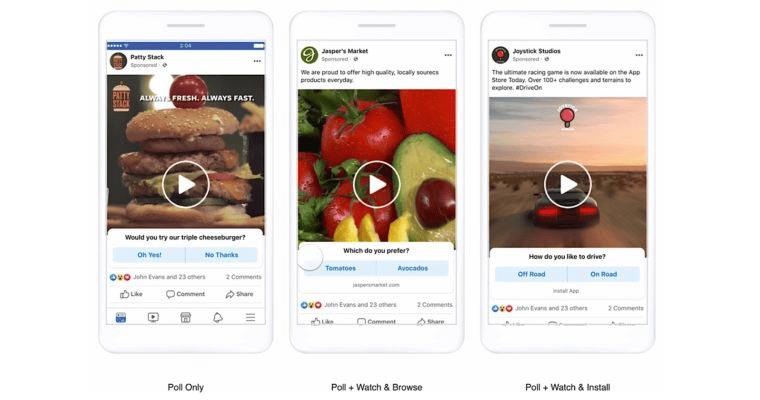
According to Damon Gochneaur, founder and managing partner of Aspiro Agency, the number one tip to reduce Facebook ad costs is to use video wherever possible. On average, video ads account for 10% of the cost of carousel or single image ads.
3. Optimize Ad Content and Images
If you include too much text in your images, Facebook will increase your ad bid. Testing multiple headlines can help optimize your ad costs and determine which messaging performs best.
4. Turn Off Ineffective Ad Sets
By testing your ad sets and ad creatives, you can identify what works and what doesn’t. After monitoring for 2-3 days, you should turn off the underperforming ad sets to save on costs.
5. Retarget Based on Segments
Segment consumers who have interacted with your Facebook page and save them as a separate audience group. Then, create campaigns specifically targeted at them.
These audiences typically perform best in terms of engagement and conversion rates. So, ensure that you are reaching them in the most effective and relevant manner.
6. A/B Testing
A/B testing is the process of running the same ad campaign twice with a small change to test performance. This allows you to continually improve your ads and make them more effective. It can help reduce Facebook ad costs by improving your return on investment (ROI).
According to some studies, certain businesses have managed to reduce their Facebook ad costs by up to 96% simply by changing the ad copy.
2. What is the minimum budget for running Facebook Ads per day?
The minimum amount Facebook requires to set up an ad campaign is 21,000 VND.
3. Is there a way to prevent Facebook from overspending my budget?
You can set a fixed daily or lifetime budget. Facebook will distribute your money over the designated time frame.
Additionally, if you set a bid, you can set a spending limit for the campaign or account to control the amount spent while running Facebook Ads.
4. How is Facebook Ads billing calculated?
- Based on a fixed cost: You can control your Facebook Ads expenditure when you spend according to a daily or lifetime budget.
- Ads Manager: The ad reporting data in Ads Manager will show the amount spent daily or monthly on each campaign.
5. Should I run Facebook Ads myself or hire a Facebook Ads service to optimize costs?
Outsourcing your ad service is a viable option. Although you may incur additional service costs, this investment can help you achieve your conversion and revenue goals more effectively.
VII. Facebook Ads Management Service Fees
Each Facebook Ads service provider will have its own pricing structure and service fee calculation method. Here are two common pricing models you can refer to:
1. Service Fee Based on Budget
A Facebook Ads provider may charge a service fee of 10%–20%, depending on the budget.
For example, if your Facebook Ads budget is 50,000,000 VND, you might pay an additional 15% fee, which equals 7,500,000 VND, to the service provider.
2. Service Fee Based on Reach or Engagement
Some providers charge a fixed fee based on the number of people reached or the level of engagement.
For example, you might pay 20,000,000 VND for 200,000 reach.
Facebook Ads costs can vary greatly and may even increase by 3 to 4 times within just a week. Therefore, avoid setting a budget or bid and relying solely on Facebook’s distribution algorithm. Instead, monitor and adjust your ads regularly to optimize your advertising spend.
If you need the most reputable payment method and advertising account provider, you can message the fanpage buybm365.com-Ads to receive advice from HT Media. In addition, you can follow the articles. Latest articles related to our Digital Marketing.